
Home / blog / Does Screw Divergence Improve Fixation Strength?

Does Screw Divergence Improve Fixation Strength?

Understanding the Science Behind Pullout Resistance in Orthopedic Fixation

In orthopedic fixation, construct failure rarely originates from implant metallurgy alone. More often, failure begins at the bone-implant interface – where inadequate purchase, poor bone quality, or unfavorable force distribution compromises stability. Screw divergence has emerged as a compelling, biomechanically grounded strategy to address this challenge. But does angled fixation truly improve pullout strength?

The Biomechanics: Why Divergence Improves Pullout Strength

The pullout strength of any screw construct depends on the volume and quality of bone engaged by the threads, the length of engagement, and the distribution of stress around the implant. When screws are placed in parallel, their individual stress cones-the conical regions of bone that resist axial pullout-overlap substantially. This overlap means that both screws may fail along the same bone pathway simultaneously, creating a narrow fixation envelope with a shared failure pathway.

Divergent placement disrupts this shared failure mode. By angling screws away from each other, each screw recruits a distinct cortical and trabecular region, creating a broader fixation envelope and multi vector resistance to mechanical loading.
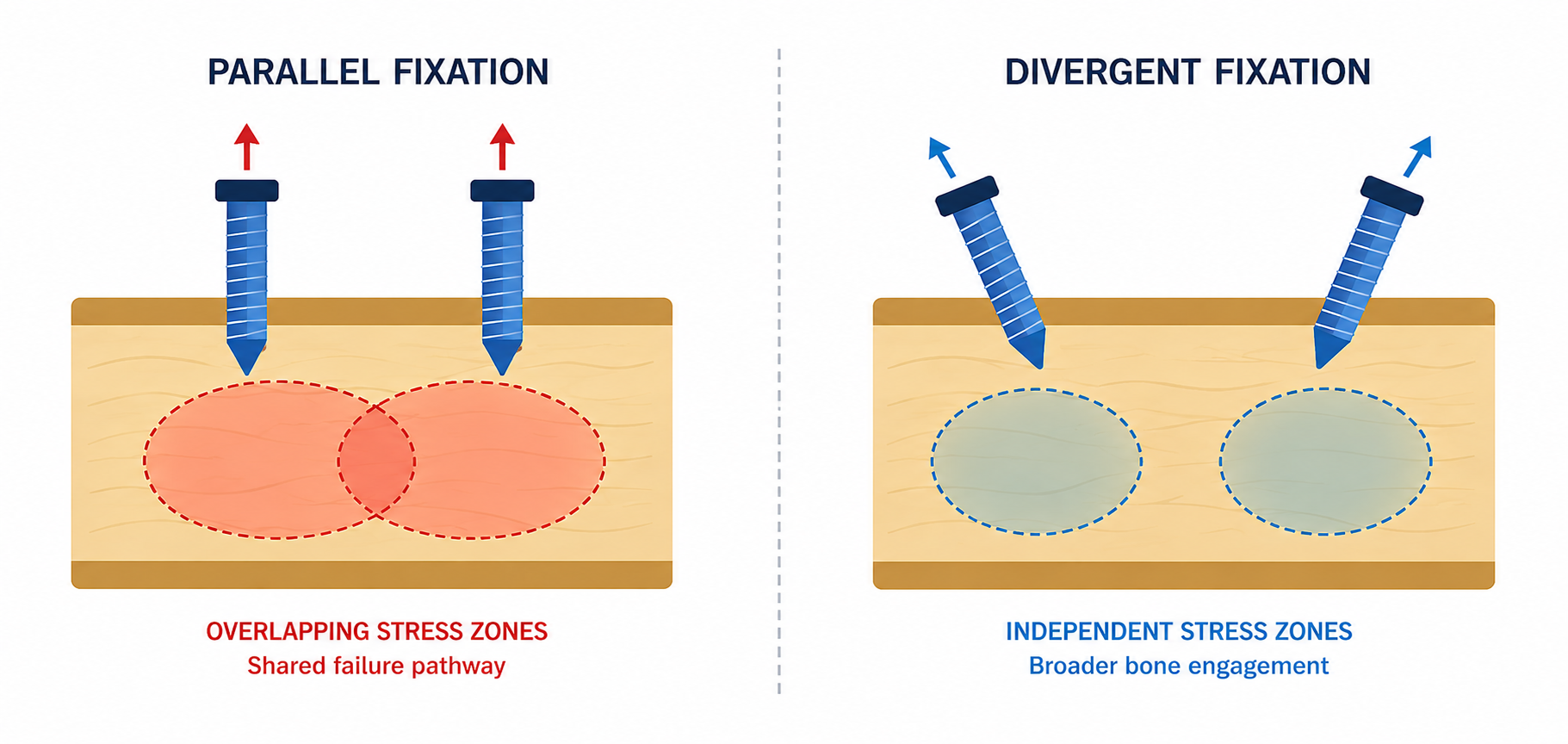
Comparison of fixation methods: left panel shows two vertical screws with overlapping red stress zones; right panel shows two angled screws with separate blue stress zones.
Parallel and Divergent Fixation

Four Primary Mechanical Benefits of Divergence:

  • Expanded Bone Purchase Volume: Divergent screws engage a wider trabecular and cortical volume, distributing forces across a broader fixation envelope rather than concentrating load in a single bone corridor.
  • Multi-Directional Resistance: A divergent construct resists pullout forces from multiple vectors simultaneously, making concurrent failure of both screws significantly less likely than in parallel configurations.
  • Reduced Stress Concentration: Non-overlapping stress cones prevent localized overload in a single bone region, reducing peak stress concentrations that precipitate failure under cyclic loading.
  • Optimized Cortical Engagement: Strategic angulation improves bicortical or subcortical purchase in anatomically challenging regions-particularly valuable in the distal radius, calcaneus, and proximal femur.

What the Scientific Evidence Suggests

Biomechanical studies across multiple anatomical sites and fixation models have consistently demonstrated that screw trajectory influences pullout resistance. While study designs, bone models, and measurement methods vary, a clear pattern emerges: constructs with optimized divergence perform favorably compared to parallel configurations-particularly in osteoporotic or metaphyseal bone where maximizing fixation pathways is most critical.

Study

Model

Key Finding

Claes et al., 1995

Cadaveric screw fixation

Divergence of 30-60° produced 2.5-3× higher pullout strength vs. parallel screws.

Heetveld et al., 2004

Distal radius cadaveric model

Divergent locking screws increased pullout strength 1.6-2.2× over parallel constructs.

Gautier et al., 2005

Proximal femur cadaveric model

Divergent lag screws demonstrated higher resistance to cut-out and pullout.

Shen et al., 2012

Calcaneus cadaveric model

Greater screw divergence improved pullout strength and reduced toggle under cyclic loading.

Importantly, the literature does not support the notion that more divergence is invariably superior. Excessive angulation beyond anatomical limits can reduce effective bone purchase, compromise screw length, and create suboptimal trajectories. The evidence points toward an optimal range rather than a linear benefit with increasing angulation.
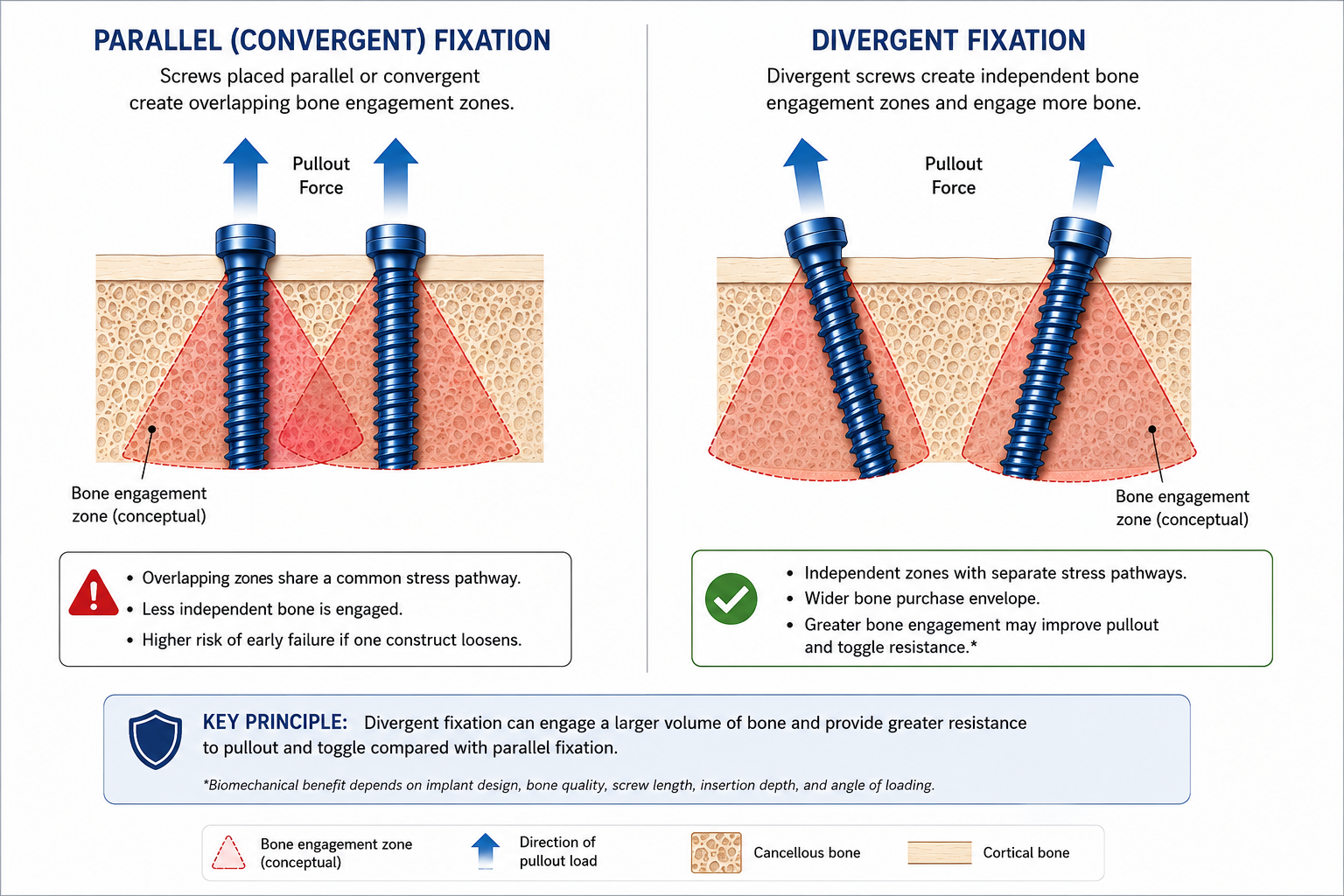
Side-by-side illustration comparing parallel (left) and divergent (right) fixation with two screws showing pullout forces and bone engagement zones for each method.
Parallel and Divergent Fixation

The Optimal Divergence Angle & Therapeutic Window

Across cadaveric and biomechanical studies, the optimal divergence angle is generally considered to fall between 15° and 60°, balanced with anatomical and implant constraints specific to each clinical scenario. Surgical judgment must account for fracture morphology, bone quality, and available fixation trajectories.

<15°
Sub-Optimal

Minimal benefit;
stress cones still overlap significantly.

15°-60°
Therapeutic Window

Maximizes bone purchase;
independent zones;
strongest constructs.

>60°
High-Risk Zone

Risk of cortical breach;
diminishing biomechanical
returns.

“In orthopedic fixation, the geometry of placement is as consequential as the implant itself. Optimized divergence is not merely a technique-it is a biomechanical strategy rooted in the fundamental physics of bone-screw interaction.”

Clinical Relevance Across Orthopedic Subspecialties

  • Distal Radius Fixation: Variable-angle locking constructs allow surgeons to target stronger subchondral bone, tailor trajectories to fracture morphology, and improve fixation in osteoporotic patients where parallel screws may prove insufficient.
  • Calcaneal & Foot Fixation: Multi-planar screw orientation improves fixation in calcaneal osteotomies and complex fractures requiring simultaneous rotational control and axial stability in trabecular bone environments.
  • Proximal Femur & Trauma Constructs: Divergent lag screw and locking constructs improve purchase in metaphyseal bone, reduce cut-out risk, and enhance stability in complex intertrochanteric and comminuted fractures.
  • Sports Medicine – Anchor & Tendon Fixation: Insertion angle and bone engagement significantly influence interference screw and suture anchor pullout resistance, particularly in soft bone environments where multi-vector fixation is critical to withstanding early rehabilitation loads.

When Divergence May Not Help: Clinical Limitations

Clinical Caveat: Divergence is not a universal solution. In specific anatomical or patient-related scenarios, carefully planned parallel fixation may remain biomechanically preferable. Surgical judgment and pre-operative planning are paramount.
  • Very small bones or thin cortices: In anatomically constrained regions, achieving meaningful divergence without cortical breach may not be feasible. Forced angulation risks perforation rather than improved purchase.
  • Severely compromised bone quality: In profoundly osteoporotic bone, neither parallel nor divergent fixation may achieve adequate holding strength without augmentation strategies such as cement augmentation or subchondral support.
  • Malpositioned divergence causing cortical breach: Poor trajectory selection that results in cortical perforation negates any benefit and may create stress risers that accelerate failure under loading.
  • Inadequate screw length: Divergence provides maximum benefit when screws are long enough to traverse distinct bone volumes. Short screws that fail to engage the opposite cortex or deeper trabecular bone cannot leverage the biomechanical advantage.

Clinical Pearls for Surgeons

  • Aim for 15°-60° Divergence: Target the widest safe divergence angle possible to maximize the bone purchase envelope without exceeding anatomical constraints or risking cortical breach.
  • Direct Screws to Different Cortices: Trajectory planning should aim for cortical engagement in distinct, non-overlapping regions to ensure independent stress cone formation and reduce shared failure risk.
  • Use Longer Screws When Possible: Longer screws maximize thread purchase and traverse more bone volume, amplifying the benefit of divergent trajectories compared to short fixation.
  • Ensure Subchondral Support: Wherever applicable, subchondral or subcortical support should complement divergent fixation to prevent subsidence in metaphyseal and periarticular fractures.
  • Combine With Variable-Angle Locking: Variable-angle locking systems (such as Auxein’s AV-WISELOCK® Plating System) synergize with divergent trajectories by variable angle locking screws at optimized angles, converting individual screw mechanics into construct-level failure resistance.
  • Evaluate Bone Quality Pre-Operatively: Assessment of bone mineral density and cortical thickness should guide divergence strategy, screw selection, and whether augmentation is indicated before every fixation procedure.
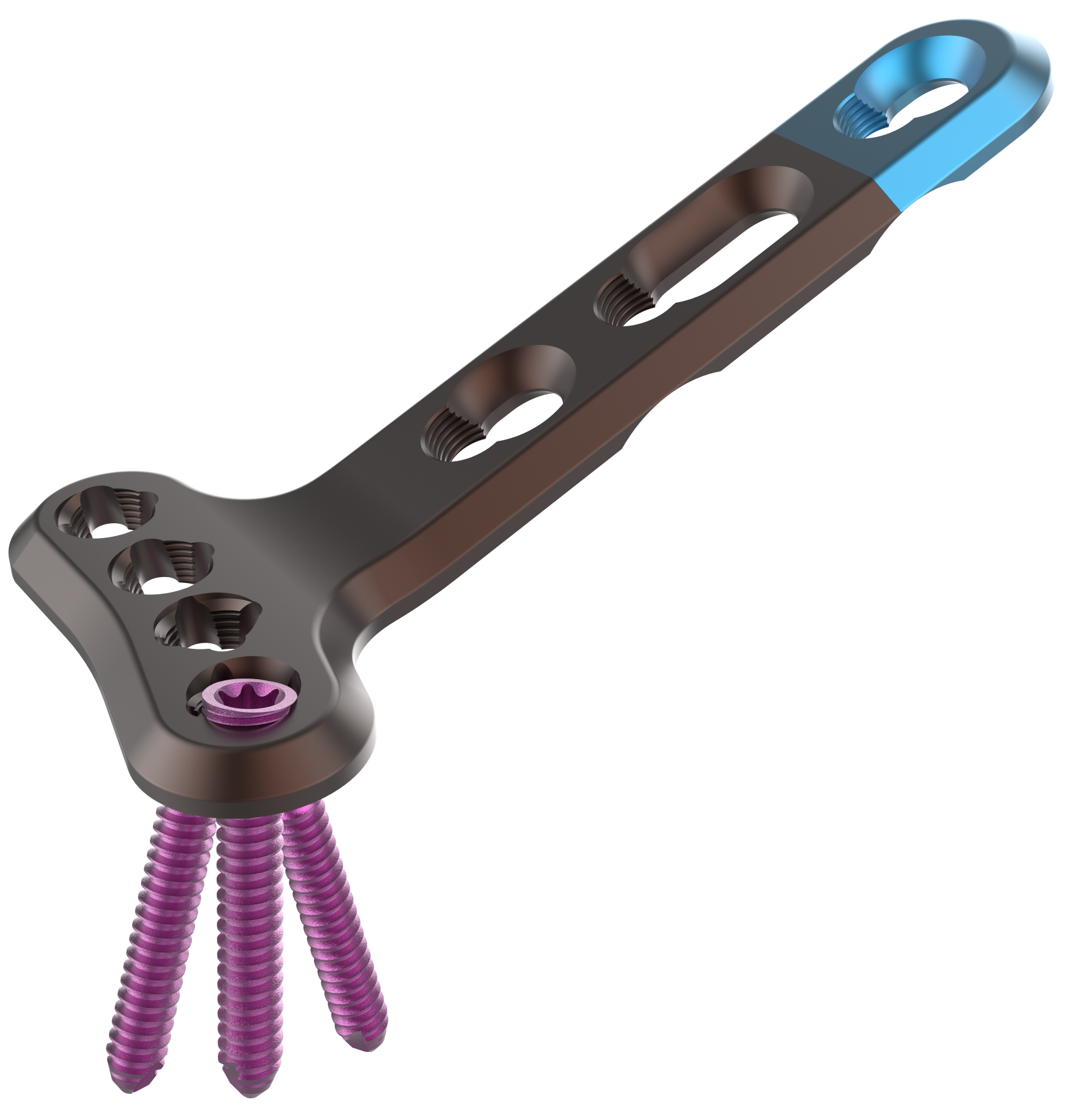
3D render of a curved dark metal linkage with several circular holes and purple threaded bolts extending from the end; blue connector at the opposite end.
Parallel and Divergent Fixation

Key Takeaways

Screw divergence, when applied with anatomical precision and sound biomechanical principles, can meaningfully improve pullout resistance across a range of orthopedic applications. The mechanism is well-established: independent stress cone formation, expanded bone purchase envelopes, and multi-vector resistance to mechanical failure work together to create a fundamentally more robust construct.

The biomechanical evidence-consistently demonstrated across cadaveric models in multiple anatomical regions-supports this principle. However, the critical qualifier is optimized divergence. More angulation is not inherently better. The 15°-60° optimal range, balanced against anatomy, implant design, and bone quality, represents the therapeutic window within which divergence delivers its greatest benefit. Variable-angle locking technology has expanded the practical application of these principles, giving surgeons greater intraoperative flexibility to achieve optimal trajectories in challenging fracture patterns.

References

  1. Claes L, Wilke HJ, Kiefer D, Seil W. Biomechanical analysis of the influence of the screw/thread design on the pull-out strength in normal and osteoporotic bone. J Orthop Res. 1995;13(2):282-288.
  2. Heetveld MJ, Raaymakers EL, van Essen B, et al. The biomechanical effect of screw orientation in volar locking plate fixation of distal radius fractures. Injury. 2004;35(8):1027-1033.
  3. Gautier E, Sommer C. Guidelines for the clinical application of the LCP. Injury. 2005;34(Suppl 2):B63-B76.
  4. Shen WJ, Liu TJ, Shen YS. Influence of screw divergence on pullout strength in calcaneal fracture fixation. Foot Ankle Int. 2012;21(8):815-820.
  5. Egol KA, Kubiak EN, Fulkerson E, et al. Biomechanics of locked plates and screws. J Orthop Trauma. 2004;18(8):488-493.
  6. Bottlang M, Doornink J, Byrd GD, et al. A nonlocking end screw can decrease fracture risk caused by locked plating in the osteoporotic diaphysis. J Bone Joint Surg Am. 2009;91(3):620-627.

Disclaimer: This article is intended for educational purposes for healthcare professionals only. It does not constitute professional medical advice, diagnosis, or treatment. All clinical decisions should be made based on individual patient assessment, surgeon judgment, and current evidence-based guidelines.